
Typing For Work
Typing test for jobs: what employers measure and the speed each role asks for
Most pre-employment typing tests are a timed copy test of one to five minutes. The score that decides is net WPM, which is your speed after errors are taken off. Most office roles ask for 40 net WPM or more, and accuracy is usually expected to stay above 95%.
Reviewed on 25 September 2026
What a pre-employment typing test looks like
You get a passage on screen and a timer, usually between one and five minutes. You copy the passage as written, including capitals and punctuation. Some tests block the Backspace key, so a mistake stays in the text and counts against you.
Data entry roles often add a second part with numbers, addresses or form fields. That part is scored in keystrokes per hour (KPH) rather than words per minute, because the input is too short and too numeric for words to mean much.
- Copy test: a prose passage, scored in net WPM and accuracy
- Data entry test: numbers and short fields, scored in KPH and accuracy
- Transcription test: typing from audio, scored on accuracy against the recording
Gross WPM, net WPM and accuracy
A "word" in a typing test is five keystrokes, spaces and punctuation included. Gross WPM counts everything you typed. Net WPM removes the errors, and the common rule takes off one word per minute for each uncorrected error. Typing 50 gross WPM for five minutes with 10 errors leaves you at 48 net WPM.
Employers read the net figure and the accuracy together. Being fast with a lot of errors doesn't pass, because every wrong digit in a record has to be found and fixed later by someone else.
Speeds that job postings commonly ask for
There is no national standard. Each employer sets its own threshold, but postings in the same field land in similar ranges. Use these as a target, then check the posting.
- General office and admin assistant: around 40 net WPM
- Data entry clerk: 50–60 WPM or more, plus a KPH target on numeric fields
- Legal or medical secretary: 60 WPM or more
- Transcriptionist: 60–75 WPM or more, with very high accuracy
- 911 dispatcher: usually 35–45 net WPM on the CritiCall test, while also listening and entering data
Reading your KeyboardGym result against a job test
The KeyboardGym tests count only correct keystrokes, so the WPM they show is already close to a net figure. Wrong keys are not credited, but no extra penalty is added. If the employer uses the one-word-per-error rule, subtract one WPM for each error you left in, divided by the minutes of the test.
Use the 5-minute test as your main check. One minute shows your best burst. Five minutes is closer to the length of most job tests and shows whether your speed holds.
How to prepare in the week before the test
Take the 5-minute test once a day and write down net WPM and accuracy. If accuracy is under 95%, slow down until it is above that. On test day, a high net score comes from not making errors, not from rushing.
Practise on text you have not seen before. Job tests use unfamiliar passages, so a score from repeating the same text is higher than what you will get on the day.
- Keep your fingers on the home row and use all ten
- Practise the number row if the role involves data entry
- Fix errors as you go only if the test allows Backspace
- Test on the kind of keyboard you will use on the day if you can
Try a practice
Start by measuring where you are. One minute shows your ceiling, five minutes shows whether it holds. Both are free and feed the leaderboard.
1-Minute Typing Test
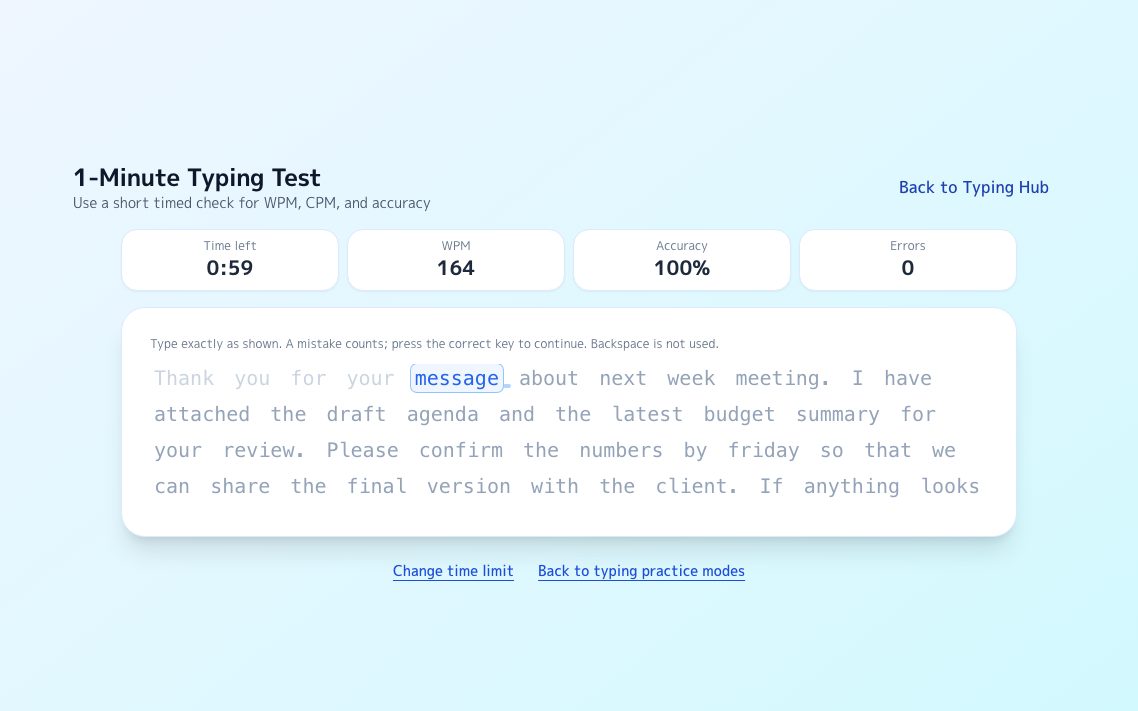
A continuous passage scrolls as you type and reports your current ceiling on the spot.
Try it →
Endurance5-Minute Typing Test
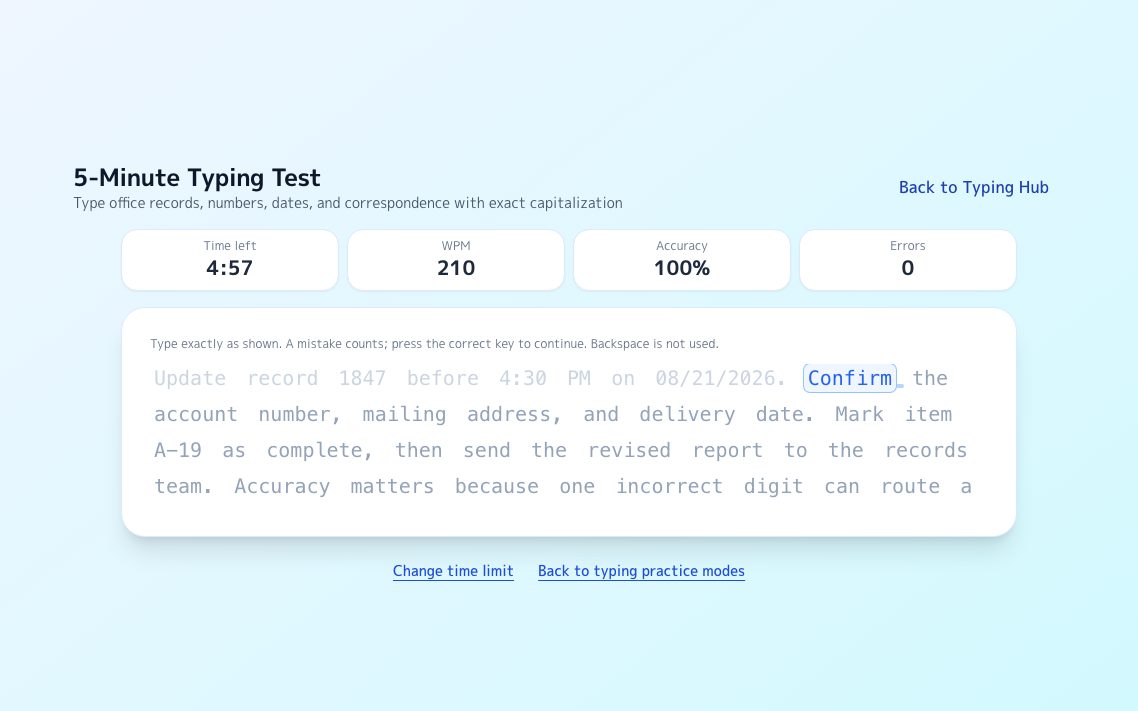
The same format for five minutes. The gap between halves exposes tension and posture.
Try it →
LeaderboardLong-Text Leaderboard
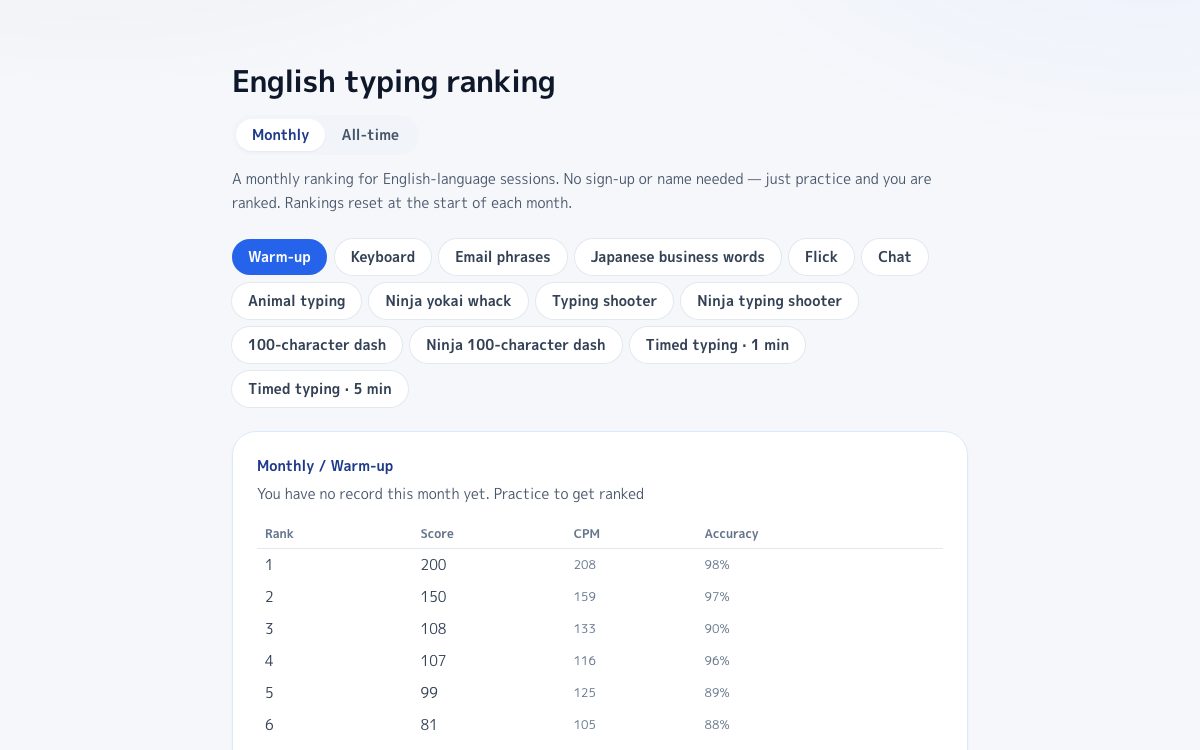
Your result lands on the leaderboard straight away, with no account needed.
Try it →
FAQ
What is a good typing speed for a job?
Around 40 net WPM with 95% accuracy covers most office roles. Data entry and transcription roles ask for more, often 50 to 75 WPM.
Do employers look at gross or net WPM?
Net WPM. It is the speed after errors are taken off, and it is almost always reported together with accuracy.
Can I use Backspace in a job typing test?
It depends on the test. Some allow corrections and count the time you lose. Others block Backspace so every error stays in. Practise both ways if you are not told in advance.
Does KeyboardGym give a typing certificate?
No. If an employer asks for a certificate, they normally name the test provider. Use KeyboardGym to practise and track your net speed before you take it.
How long does it take to go from 30 to 40 WPM?
With daily practice of 10 to 15 minutes on the home row, many people gain around 10 WPM in a few weeks. Accuracy usually improves first, and speed follows.
Sources
Wonderlic: typing speed by profession
A pre-employment test publisher's overview of the typing speeds common roles expect.
Wikipedia: Words per minute
Defines the five-keystroke word and the difference between gross and net WPM.
KeyboardGym: Excel shortcuts
Office and data entry roles often test Excel as well. Practise the shortcuts used most at work.