Typing Race
Typing Race — how fast can you clear 100 characters?
A typing race fixes the distance and lets the clock vary. In KeyboardGym’s 100-Character Dash, 100 characters are written along the lane; type them left to right and your runner advances until it crosses the finish line. The clock stops there, and that time is your record. The start follows real athletics — on your marks, set, gun — and a key pressed before the gun is a false start that disqualifies the run. This page covers the benchmark times and what to fix first when you want a faster one.
10 August 2026
How a typing race differs from a typing test
A one-minute typing test fixes the time and measures the distance: how many characters did you land in sixty seconds. A typing race does the opposite. The distance is fixed at 100 characters and the clock is what varies — the same logic as a 100-metre sprint.
That inversion changes what the number tells you. In a timed test, a stall in the middle is diluted by everything else you typed. In a race, every moment you stop is added directly to your time. Hesitate for half a second and the record is half a second worse. There is nowhere to hide.
It also makes comparison honest. Everyone runs the same 100 keystrokes, so lining times up side by side actually means something — no allowance is needed for a harder or easier set of prompts.
- Timed test: fixed time, compare characters typed
- Typing race: fixed distance, compare seconds elapsed
- Every stall lands directly on your time
- Everyone runs the same 100 keystrokes, so times are comparable
The rules of the 100-Character Dash
One hundred characters are written along the lane. Type them from the left and your runner moves right in proportion to what you have landed. The clock stops when the hundredth character goes in.
The start follows athletics. On your marks, then set, then the gun. The wait before the gun changes every run, so you cannot memorise the timing and jump early. Press any key before the gun and it is a false start: the run ends there and nothing is recorded.
There is exactly one accepted spelling. Only the characters shown on the lane count, and no alternative spelling is accepted. That is not pedantry — if the number of keystrokes could vary from runner to runner, a 100-character race would no longer be a 100-keystroke race, and the times would stop being comparable.
A wrong key does not end the race. The runner stumbles in place until you land the right character, then carries on. The lost time lands on your clock, and the miss count and accuracy are recorded alongside it.
- Exactly 100 characters, rebuilt at random every run
- On your marks, set, gun — the wait varies every time
- A key before the gun is a false start and a disqualification
- Only the exact spelling on the lane is accepted
- A miss stalls the runner rather than ending the race
Benchmark times — what counts as fast over 100 characters
A raw time is hard to judge on its own, so here it is converted to characters per minute. From your finish time, CPM is simply 6000 divided by the seconds. Sixty seconds is 100 CPM; twenty seconds is 300 CPM. Divide CPM by five for the rough WPM equivalent.
Aim to break thirty seconds first. Past that point, typing stops being the bottleneck in everyday writing — you compose faster than you type rather than the other way round.
- 60s (100 CPM, ~20 WPM): still learning where the keys are
- 40s (150 CPM, ~30 WPM): you know the keys but hunt for them visually
- 30s (200 CPM, ~40 WPM): the working minimum for office work
- 20s (300 CPM, ~60 WPM): people describe you as a fast typist
- 15s (400 CPM, ~80 WPM): advanced — words appear as fast as you think them
- 12s (500 CPM, ~100 WPM): the entry point to competitive typing
- 10s (600 CPM, ~120 WPM): elite, and only reachable with a clean run
The order in which to cut your time
Almost everyone starts by trying to move their fingers faster. That is the wrong end of the problem. Speed pressure produces misses, a miss stalls the runner, and the correction costs more time than the extra speed ever saved.
Work down this list instead, in order.
Reaction time comes last for a reason. It is worth two or three tenths of a second against a run measured in tens of seconds. Chasing the gun is not worth the risk of losing the whole attempt to a false start.
- 1. Remove the misses — one miss costs roughly three keystrokes, or half a second to a second
- 2. Find where you stall — if one letter pair stops you every run, drill that pair alone
- 3. Read ahead — look two or three characters past the one you are typing, and your hands stop pausing
- 4. Sharpen your reaction — last, and least worth the risk
How to avoid a false start
Most false starts come from tension in the set position. If your fingers are already pressing into the keys while you wait, a small jolt of anticipation is enough to push one down.
On set, rest your fingers on the home row and let them go slack. You are placing them, not loading them. Tensing only after the gun costs you around two tenths of a second — far less than losing an entire run.
One thing that does help is reading ahead before the gun. During the second or two on your marks, read the first few characters at the left end of the lane. You are not moving, so it is not a false start, and you save the reading time once the clock is live.
- On set, relax your fingers — do not pre-load the keys
- Read the first few characters while you wait
- The wait varies every run, so sit through a long one
- Not being disqualified beats a sharper reaction every time
What to do after the race
A race measures where you are; it does not, on its own, train you. When your time plateaus, go and practice whatever is causing the stall.
If misses are the problem, your finger assignments have drifted, and the home row warm-up is the fastest route back. If particular words stop you, drill a mode that contains them. If you want the writing you actually do at work to get faster, practice on business phrases and email wording directly.
If it is the reflex game you enjoy, Animal Typing and the Business Typing Shooter scratch the same itch and finish just as quickly, so you can run several in a sitting.
- Lots of misses → go back to the home row warm-up
- Stalling on particular words → drill those words directly
- Fading over long text → the 1-minute and 5-minute typing tests
- Want to keep playing → Animal Typing or the Business Typing Shooter
Try a practice
These are the next drills that are easy to try after this guide, without forcing a jump that is too steep.
Long-Text Typing Test
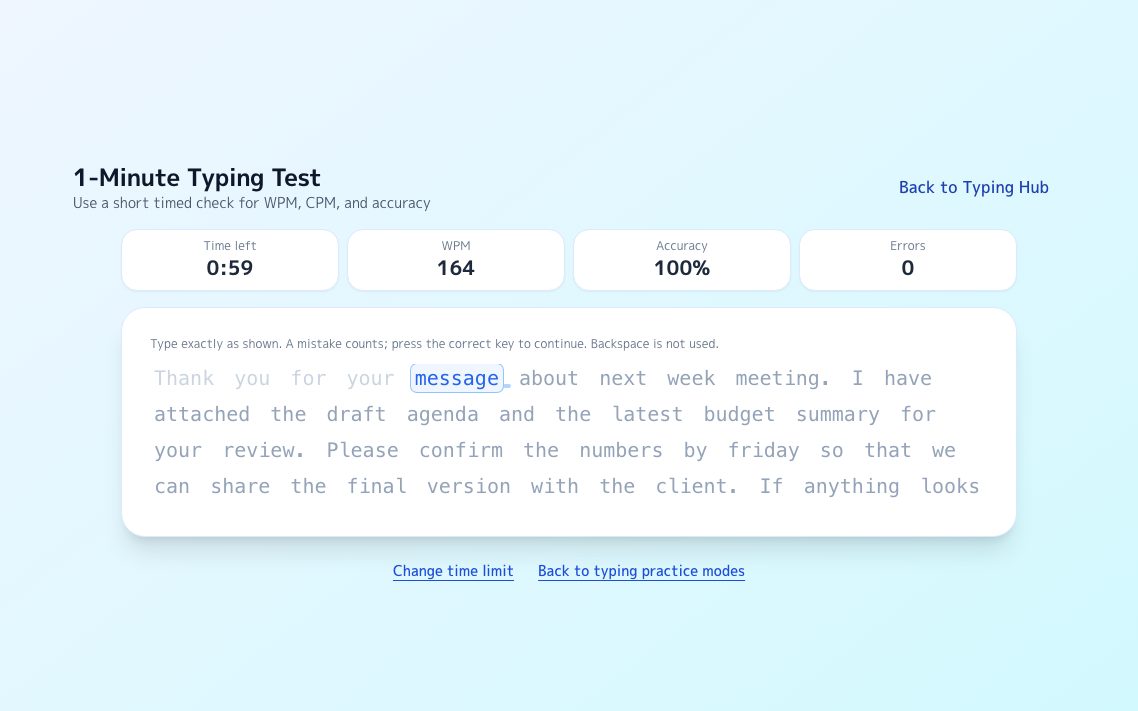
Continuous text scrolls as you type, reporting WPM and accuracy on the spot.
Try it →
Standard drillEnglish Typing Practice
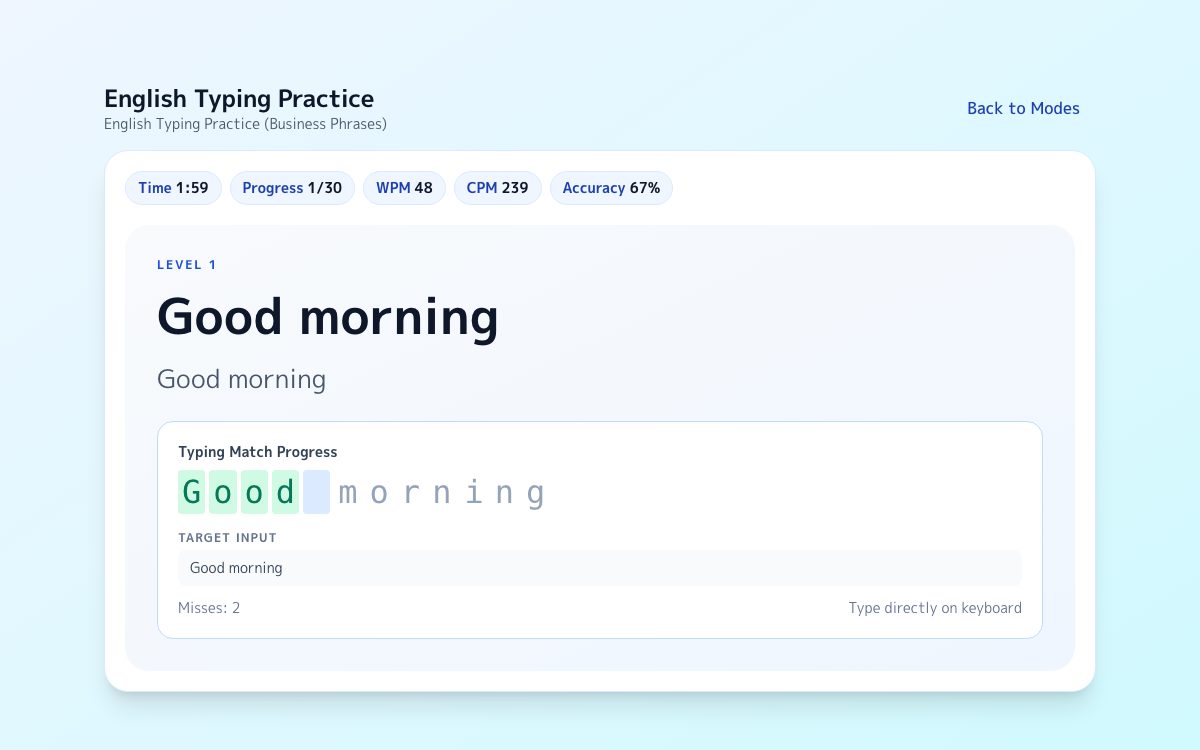
The default mode for building accuracy from short prompts to longer passages.
Try it →
Work checkBusiness Chat Practice
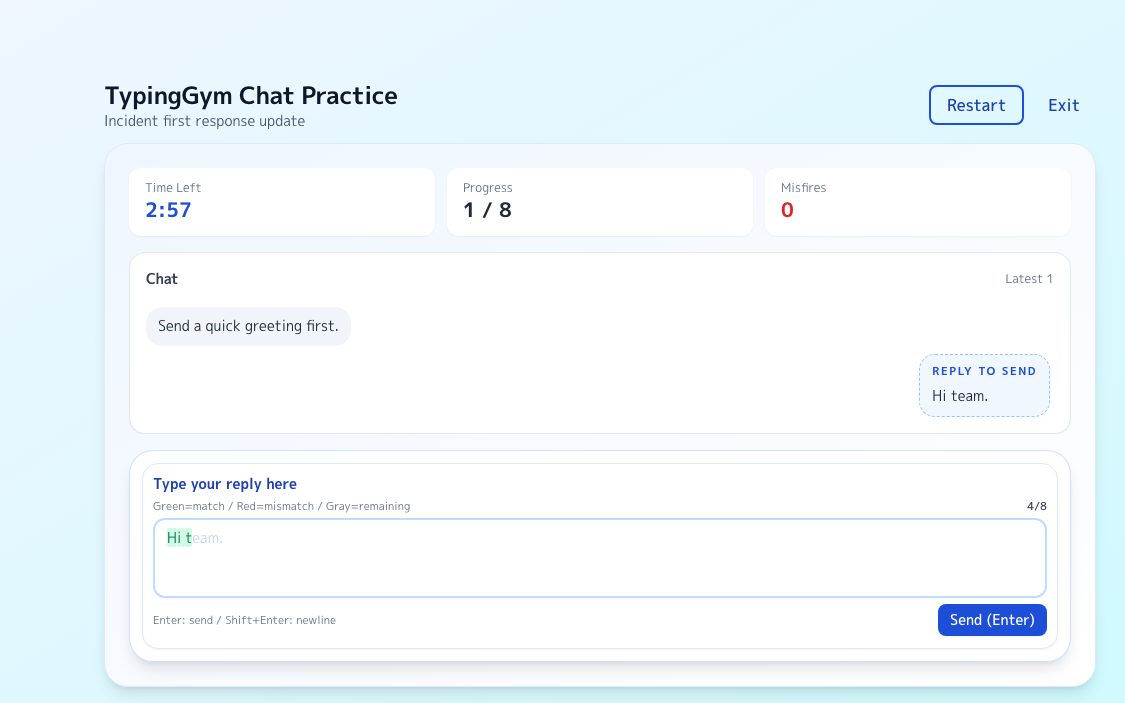
Validate repeatable accuracy on work-style messages with Enter and newline handling.
Try it →
FAQ
What is a typing race?
It is a typing game where the distance is fixed and only the time varies. In KeyboardGym’s 100-Character Dash, your record is the number of seconds it takes to clear the 100 characters written on the lane, rather than the number of characters you land in a fixed minute.
How fast should I clear 100 characters?
Under thirty seconds is enough for ordinary office work, and under twenty seconds is where people start calling you a fast typist. Fifteen seconds is 400 characters per minute and counts as advanced; under twelve seconds is the entry point to competitive typing.
What happens if I false start?
Pressing a key before the gun ends the run immediately as a disqualification. No time is recorded and nothing is submitted to the ranking. You can step back up to the line and try again as many times as you like.
Are alternative spellings accepted?
No. Only the exact characters shown on the lane count. If different runners could clear the race in different numbers of keystrokes, the times would no longer be comparable, which is the whole point of a fixed distance.
Does a typo end the race?
No. The runner stalls in place until you type the correct character and then continues. The time you lost is on your clock, and your miss count and accuracy are recorded with the result.
Can I play on a phone?
Yes. On a phone an on-screen keyboard appears at the bottom of the screen, so you type one letter at a time with no autocorrect in between. On a computer, just use your usual keyboard.
Does my time go on a ranking?
Yes. Finishing submits your run to the monthly English ranking and shows your position straight away. No account and no name registration are required.