
Japanese Typing Chart
How to Type Japanese: the Complete Romaji Chart
Japanese can be typed two ways, and the one almost everyone uses turns romaji into kana as you go. Most of it is regular — か is ka, さ is sa — but the small tsu, the long vowel bar and the syllabic n follow rules you cannot guess by listening. This page collects every one of them in one place, with charts you can check at a glance and drills you can start straight away.
Reviewed on August 9, 2026
How Japanese input works: romaji input and kana input
There are two ways to type Japanese: romaji input and kana input.
Keyboards sold in Japan (the JIS layout) do print kana on the keys, and kana input uses them directly — one key per kana, so fewer keystrokes. The trade-off is around fifty key positions to memorise, and hardware sold outside Japan carries no kana markings at all.
That is why romaji input is what most people use, native speakers included. You type the romaji and your input method turns it into kana as you go. This page, and every drill on this site, describes romaji input.
To write にほん you press n, i, h, o, n and にほん appears. Press the space bar and it becomes 日本. That step is called conversion, and it is the part that turns kana into kanji.
Everything below is about the first step: getting the right kana on screen. Once that is automatic, conversion is just a space bar press.
- Type romaji → kana appear
- Press space → kanji or katakana candidates appear
- Press Enter → the text is fixed
The basic kana chart
This is the core table. Almost every kana is a consonant plus a vowel: か is k plus a, so you type ka.
Only four break the pattern. し is shi, ち is chi, つ is tsu and ふ is fu. Your IME also accepts si, ti, tu and hu, but the Hepburn spellings are the ones printed on passports and station signs, so they are worth learning first.
| Row | a | i | u | e | o |
|---|---|---|---|---|---|
| あ | あa | いiyi | うuwu | えe | おo |
| か | かkaca | きki | くkucu / qu | けke | こkoco |
| さ | さsa | しshisi | すsu | せsece | そso |
| た | たta | ちchiti | つtsutu | てte | とto |
| な | なna | にni | ぬnu | ねne | のno |
| は | はha | ひhi | ふfuhu | へhe | ほho |
| ま | まma | みmi | むmu | めme | もmo |
| や | やya | ゆyu | よyo | ||
| ら | らra | りri | るru | れre | ろro |
| わ | わwa | をwoo | |||
| ん | んnnn / n' |
The blue spelling is the usual one. The small grey spelling below produces the same kana.
Voiced and semi-voiced kana
These are the kana with two small dots (が, ざ, だ, ば) or a small circle (ぱ). Nothing new to memorise — only the first letter changes.
か becomes が by turning k into g. は becomes ば with b, and ぱ with p.
| Row | a | i | u | e | o |
|---|---|---|---|---|---|
| が | がga | ぎgi | ぐgu | げge | ごgo |
| ざ | ざza | じjizi | ずzu | ぜze | ぞzo |
| だ | だda | ぢdiji | づduzu | でde | どdo |
| ば | ばba | びbi | ぶbu | べbe | ぼbo |
| ぱ | ぱpa | ぴpi | ぷpu | ぺpe | ぽpo |
The blue spelling is the usual one. The small grey spelling below produces the same kana.
Contracted sounds: the small ya, yu, yo
きゃ is not ki + ya. It is kya. The small ゃ, ゅ and ょ merge with the kana before them into one beat, so the romaji is one unit too.
This is where meaning depends on your spelling. 今日 (きょう, today) is kyou — two beats. 器用 (きよう, dexterous) is kiyou — three. 費用 (ひよう, cost) is hiyou, not hyou. A wrong spelling here gives you a different word, not a typo.
Because し, ち and じ are already irregular, their contracted forms look different: sha, cha and ja rather than shya, chya and jya.
| Row | ya | yu | yo |
|---|---|---|---|
| き | きゃkya | きゅkyu | きょkyo |
| し | しゃshasya | しゅshusyu | しょshosyo |
| ち | ちゃchacya / tya | ちゅchucyu / tyu | ちょchocyo / tyo |
| に | にゃnya | にゅnyu | にょnyo |
| ひ | ひゃhya | ひゅhyu | ひょhyo |
| み | みゃmya | みゅmyu | みょmyo |
| り | りゃrya | りゅryu | りょryo |
| ぎ | ぎゃgya | ぎゅgyu | ぎょgyo |
| じ | じゃjajya / zya | じゅjujyu / zyu | じょjojyo / zyo |
| び | びゃbya | びゅbyu | びょbyo |
| ぴ | ぴゃpya | ぴゅpyu | ぴょpyo |
The blue spelling is the usual one. The small grey spelling below produces the same kana.
Contracted sounds in workplace vocabulary
Contracted sounds are everywhere in business Japanese. These are the words worth drilling until they are automatic.
- 承知 — しょうち — shouchi — acknowledgement, consent
- 了解 — りょうかい — ryoukai — understood, roger
- 修正 — しゅうせい — shuusei — revision, correction
- 上司 — じょうし — joushi — one’s boss
- 情報 — じょうほう — jouhou — information
- 社長 — しゃちょう — shachou — company president
- 商品 — しょうひん — shouhin — product, merchandise
- 業務 — ぎょうむ — gyoumu — operations, duties
- 給与 — きゅうよ — kyuuyo — salary
- 休暇 — きゅうか — kyuuka — leave, time off
- 調整 — ちょうせい — chousei — coordination, adjustment
- 注文 — ちゅうもん — chuumon — order (from a customer)
- 集中 — しゅうちゅう — shuuchuu — concentration
- 資料 — しりょう — shiryou — materials, handouts
- 発表 — はっぴょう — happyou — presentation, announcement
- 病院 — びょういん — byouin — hospital
- お客様 — おきゃくさま — okyakusama — customer (polite)
- 対処 — たいしょ — taisho — handling, dealing with
- 部長 — ぶちょう — buchou — department head
- 費用 — ひよう — hiyou — cost (hi-yo-u, not hyo-u)
- 今日 — きょう — kyou — today (one beat: kyo-u)
- 器用 — きよう — kiyou — dexterous (two beats: ki-yo-u)
Typing a small kana on its own
To produce a small kana by itself, put x in front of it. ぁ is xa and ゃ is xya. An l works the same way, so la and lya also work.
You rarely need this. きゃ is faster as kya, and the small tsu is faster as a doubled consonant. Keep x for the cases where you genuinely want a small kana standing alone.
ぁxa | ぃxi | ぅxu | ぇxe | ぉxo |
ゃxya | ゅxyu | ょxyo | っxtu |
The small tsu: double the next consonant
The small っ has no sound of its own, and no key. You type the first consonant of the following sound twice.
切手 (きって, stamp) is followed by て (te), so you double the t: kitte. 学校 (がっこう, school) is followed by こ (ko), so you double the k: gakkou.
出張 (しゅっちょう) is the case that trips people up. The following sound is ちょ, whose romaji starts with c, so you double the c: shucchou. Always look at the next sound, not at how the syllable looks.
- 出張 — しゅっちょう — shucchou — business trip
- 発注 — はっちゅう — hacchuu — placing an order
- 発送 — はっそう — hassou — shipping, dispatch
- 発行 — はっこう — hakkou — issuing a document
- 実績 — じっせき — jisseki — track record, actual results
- 実践 — じっせん — jissen — putting into practice
- 一括 — いっかつ — ikkatsu — in a lump, all at once
- 一致 — いっち — icchi — agreement, a match
- 決算 — けっさん — kessan — financial closing
- 決裁 — けっさい — kessai — approval by a superior
- 決着 — けっちゃく — kecchaku — settlement, conclusion
- 却下 — きゃっか — kyakka — rejection
- 徹底 — てってい — tettei — thoroughness
- 発足 — ほっそく — hossoku — launch of a team or project
- 失敗 — しっぱい — shippai — failure
- 一般的 — いっぱんてき — ippanteki — general, typical
- 出席 — しゅっせき — shusseki — attendance
- 欠席 — けっせき — kesseki — absence
- 結果 — けっか — kekka — result
- 出発 — しゅっぱつ — shuppatsu — departure
- 撤回 — てっかい — tekkai — withdrawal of a statement
- 突破 — とっぱ — toppa — breaking through a figure
Long vowels: the hyphen key
The katakana lengthening bar ー is the hyphen key, just right of 0 on a US layout.
メーカー is me-ka- and データ is de-ta. Typing the English spelling — maker, data — produces nothing useful, because the IME is matching kana, not words.
Long vowels in hiragana are different: とうきょう uses a plain u, not a bar. The bar belongs to katakana only.
- メーカー — めーかー — me-ka- — manufacturer
- サービス — さーびす — sa-bisu — service
- ミーティング — みーてぃんぐ — mi-thingu — meeting
- レポート — れぽーと — repo-to — report
- データ — でーた — de-ta — data
- ユーザー — ゆーざー — yu-za- — user
- リーダー — りーだー — ri-da- — leader
- マネージャー — まねーじゃー — mane-ja- — manager
- マーケティング — まーけてぃんぐ — ma-kethingu — marketing
- ターゲット — たーげっと — ta-getto — target
- スケジュール — すけじゅーる — sukeju-ru — schedule
- メール — めーる — me-ru — email
- チーム — ちーむ — chi-mu — team
- ツール — つーる — tsu-ru — tool
- ルール — るーる — ru-ru — rule
- コピー — こぴー — kopi- — copy
- サーバー — さーばー — sa-ba- — server
- パートナー — ぱーとなー — pa-tona- — partner
- カレンダー — かれんだー — karenda- — calendar
- セミナー — せみなー — semina- — seminar
- ページ — ぺーじ — pe-ji — page
- アップデート — あっぷでーと — appude-to — update
- レビュー — れびゅー — rebyu- — review
- プロジェクト — ぷろじぇくと — purojekuto — project
- チェック — ちぇっく — chekku — check
- サポート — さぽーと — sapo-to — support
- キャンセル — きゃんせる — kyanseru — cancellation
The n / nn rule
案件 (あんけん) types fine as anken. The next sound starts with k, so a single n can only be ん.
But 全員 (ぜんいん) typed as zenin gives ぜにん, because the next sound is a vowel and the n gets pulled into に. You need zennin.
One line covers it: type nn before a vowel, before y, and at the end of a word. A single n is enough everywhere else. If you would rather not think about it, nn is always accepted.
- 案内 — あんない — annai — guidance, informing someone
- 全員 — ぜんいん — zennin — everyone (type nn before a vowel)
- 原因 — げんいん — gennin — cause of a problem
- 満員 — まんいん — mannin — full, no seats left
- 案件 — あんけん — anken — a matter, a deal
- 検討 — けんとう — kentou — consideration, review
- 確認 — かくにん — kakunin — confirmation
- 返信 — へんしん — henshin — reply to a message
- 進捗 — しんちょく — shinchoku — progress
- 分析 — ぶんせき — bunseki — analysis
- 品質 — ひんしつ — hinshitsu — quality
- 金額 — きんがく — kingaku — amount of money
- 参加 — さんか — sanka — participation
- 単価 — たんか — tanka — unit price
Loanword sounds
Katakana words use sounds that native Japanese words do not have: the ファ of ファイル, the ティ of ミーティング.
ふぁ is fa and てぃ is thi, which makes ミーティング mi-thingu. These are the spellings most guides leave out, and the reason loanwords feel harder to type than they should.
ふぁfa | ふぃfi | ふぇfe | ふぉfo |
うぃwiwhi | うぇwewhe | うぉwho | ゔvu |
しぇshesye | じぇjejye / zye | ちぇchecye / tye | |
つぁtsa | つぃtsi | つぇtse | つぉtso |
てぃthi | てゅthu | でぃdhidi | でゅdhu |
とぅtwu | どぅdwu |
The blue spelling is the usual one. The small grey spelling below produces the same kana.
Punctuation
Japanese punctuation comes from ordinary keys while the IME is on. The full stop 。 is the period key and the comma 、 is the comma key.
The middle dot ・ is the slash, and the lengthening bar ー is the hyphen.
。. | 、, | ・/ | ー- |
!! | ?? | (( | )) |
Alternative spellings
Several kana accept more than one spelling, and both give exactly the same result.
し is shi or si; じ is ji or zi. Learning the Hepburn set (shi, chi, tsu, fu) pays off outside the keyboard too, since that is what appears on official documents.
One pair is not interchangeable: づ is du. Typing zu gives you ず instead. 手続き (てつづき, procedure) is tetsuduki, never tetsuzuki.
| Kana | Type this |
|---|---|
| し | shi / si |
| ち | chi / ti |
| つ | tsu / tu |
| ふ | fu / hu |
| じ | ji / zi |
| づ | du / zu |
| ぢ | di / ji |
| を | wo / o |
| ん | n / nn / n' |
| しゃ | sha / sya |
| しゅ | shu / syu |
| しょ | sho / syo |
| ちゃ | cha / cya / tya |
| ちゅ | chu / cyu / tyu |
| ちょ | cho / cyo / tyo |
| じゃ | ja / jya / zya |
| じゅ | ju / jyu / zyu |
| じょ | jo / jyo / zyo |
Words with shi, chi, tsu, fu and du
These are the sounds people get wrong when they type by ear. Drill them inside real words.
- 手続き — てつづき — tetsuduki — procedure, paperwork (づ = du)
- 続き — つづき — tsuduki — continuation (つ = tsu, づ = du)
- 都合 — つごう — tsugou — availability, convenience
- 通知 — つうち — tsuuchi — notification
- 追加 — ついか — tsuika — addition
- 支社 — ししゃ — shisha — branch office (し = shi)
- 数字 — すうじ — suuji — figure, numeral (じ = ji)
- 不在 — ふざい — fuzai — being away from one’s desk (ふ = fu)
- 直接 — ちょくせつ — chokusetsu — directly (ち = chi)
Converting to kanji and katakana
Once the kana are on screen, press the space bar. A list of kanji candidates appears; press space again to move down it, and Enter to accept.
For katakana, press F7. Type めーかー, press F7, and you get メーカー. F6 forces hiragana and F10 forces plain letters — useful when the IME guesses wrong.
The drills on this site skip conversion entirely. You type the romaji shown on screen and it is checked directly, so you can practice without installing a Japanese IME at all.
- Space — convert to kanji
- Enter — accept the text
- F7 — force katakana
- F6 — force hiragana
- F10 — force plain letters
Moving from words to sentences
When single words are automatic, add particles. を is typed wo, は is typed ha and へ is typed he — you type what is written, not what is pronounced (o, wa, e).
Sentences also surface rules that words hide. In 失敗の原因を報告します the ん of げんいん is followed by を, which can begin with a vowel, so it needs nn: genninnwo. Drilling 原因 on its own would never show you that.
- 承知しました — しょうちしました — shouchishimashita — Understood. (polite)
- 了解です — りょうかいです — ryoukaidesu — Got it. (casual, for colleagues)
- 出張報告書 — しゅっちょうほうこくしょ — shucchouhoukokusho — business trip report
- 発注書 — はっちゅうしょ — hacchuusho — purchase order
- 一括払い — いっかつばらい — ikkatsubarai — lump-sum payment
- 請求書を発行します — せいきゅうしょをはっこうします — seikyuushowohakkoushimasu — I will issue the invoice.
- 手続きを進めます — てつづきをすすめます — tetsudukiwosusumemasu — I will move the paperwork forward.
- 意見が一致しました — いけんがいっちしました — ikengaicchishimashita — We reached agreement.
- 決裁をお願いします — けっさいをおねがいします — kessaiwoonegaishimasu — Please give your approval.
- 徹底的に確認します — てっていてきにかくにんします — tetteitekinikakuninshimasu — I will check it thoroughly.
- プロジェクトが発足しました — ぷろじぇくとがほっそくしました — purojekutogahossokushimashita — The project has been launched.
- お客様に発送しました — おきゃくさまにはっそうしました — okyakusamanihassoushimashita — We shipped it to the customer.
- スケジュールを調整します — すけじゅーるをちょうせいします — sukeju-ruwochouseishimasu — I will adjust the schedule.
- データをアップデートしました — でーたをあっぷでーとしました — de-tawoappude-toshimashita — I updated the data.
- マネージャーに報告します — まねーじゃーにほうこくします — mane-ja-nihoukokushimasu — I will report to the manager.
- 失敗の原因を報告します — しっぱいのげんいんをほうこくします — shippainogenninnwohoukokushimasu — I will report the cause of the failure.
How to practice
Do not chase speed at the start. Until the rules fire without conscious thought, accuracy is the only number worth watching. Once you are under ten percent misses, start pushing the pace.
There are two drills. The kana drill walks through every kana in order, from a, i, u, e, o to punctuation. Japanese Business Words takes the special moras into real workplace vocabulary, with a translation on every prompt.
A session is three to five minutes. Even one a day noticeably shortens the time it takes for the rules to become automatic.
- First: the kana drill — every kana, in order
- Then: Japanese Business Words (beginner) — special moras in workplace vocabulary
- Checkpoint: the one-minute typing test, to see your current speed
Try a practice
These are the next drills that are easy to try after this guide, without forcing a jump that is too steep.
Kana Typing Drill
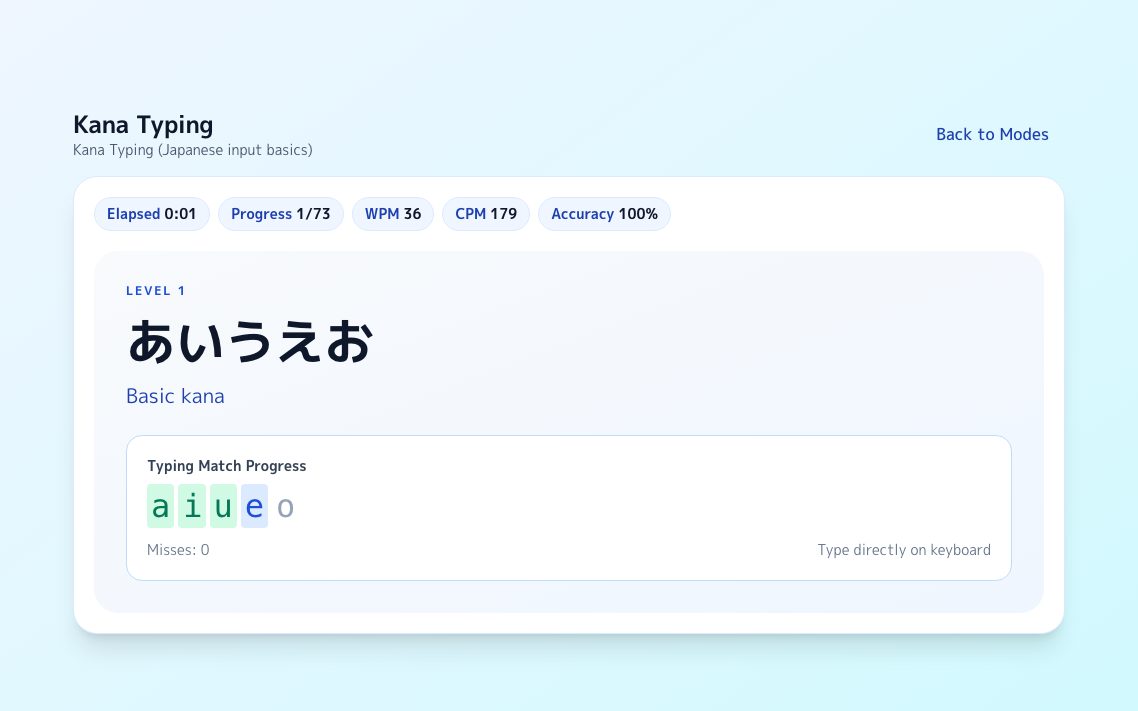
Every kana in order, from a, i, u, e, o through voiced kana, contracted sounds, small kana and punctuation.
Try it →
Then real wordsJapanese Business Words: Beginner
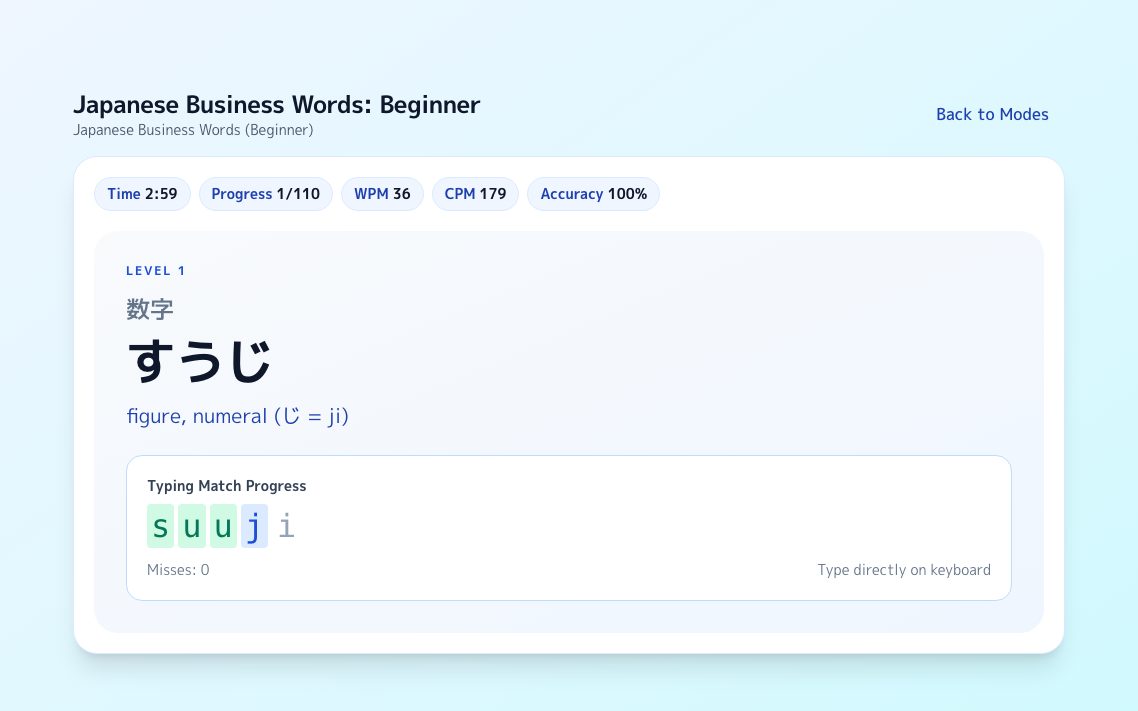
The small tsu, the long vowel bar and the n / nn rule, drilled across 108 workplace words with translations.
Try it →
Measure your speed1-Minute Typing Test
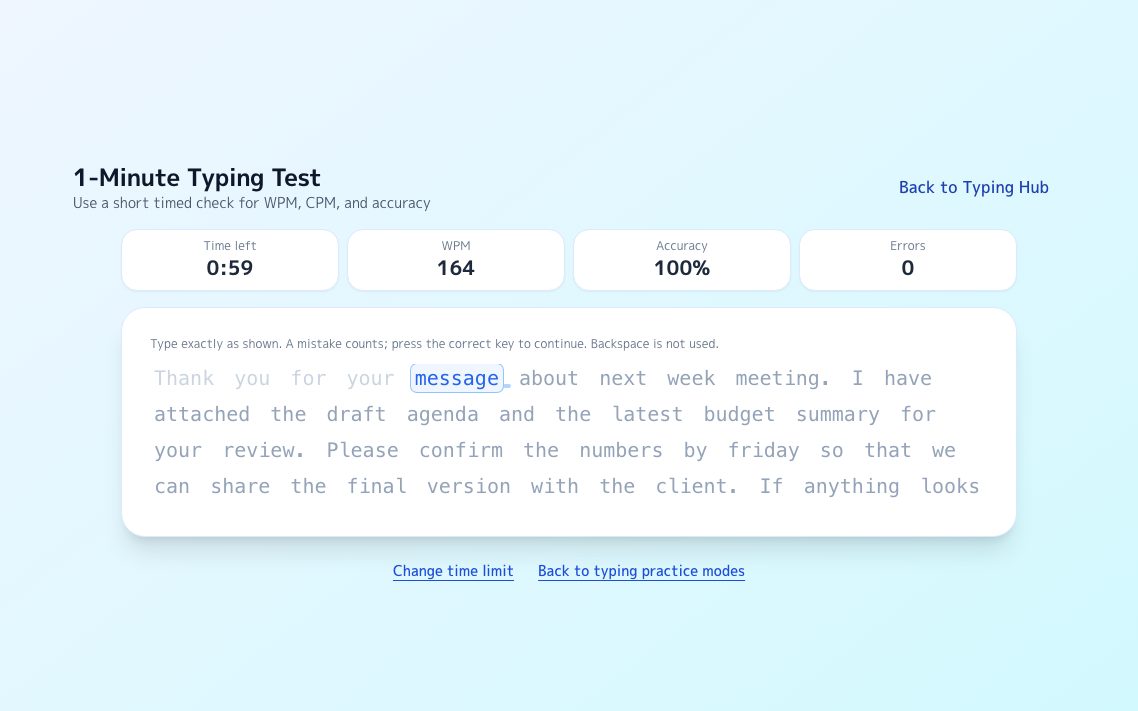
Once the rules are automatic, measure your speed and compare it with native typists.
Try it →
FAQ
Do I need a Japanese IME installed?
No. These drills never convert to kanji. You type the romaji shown on screen and it is checked directly, so an ordinary English keyboard is enough.
How do I type the small tsu?
Double the consonant of the following sound. 切手 (きって) is followed by te, so it is kitte. To produce a standalone っ, type xtu or ltu.
How do I type a small ya or a small a?
Put x in front: ゃ is xya and ぁ is xa. An l works too. But when the small kana follows another kana, as in きゃ, kya is faster.
When do I type n and when do I type nn?
Type nn before a vowel, before y, and at the end of a word. 全員 is zennin; 案件 is anken. When in doubt, nn is always accepted.
Which key produces the ー bar?
The hyphen key, to the right of 0 on a US layout. メーカー is typed me-ka-.
Is shi or si correct?
Both produce し. Hepburn spellings (shi, chi, tsu, fu) are the ones used on passports and public signage, so they transfer better outside the keyboard.
Can I practice kana input instead?
These drills are romaji only. Kana input needs a JIS keyboard with kana printed on the keys. It takes fewer keystrokes per kana, but it means learning around fifty key positions, and the hardware is hard to find outside Japan. Romaji input works on any keyboard.
How do I switch to katakana?
Type the kana, then press F7. めーかー becomes メーカー.
Can I practice on a phone?
Yes. A romaji keyboard appears at the bottom of the screen. To practice Japanese flick input instead, use the flick practice mode.