A-Z Typing Speed
Alphabet typing speed: how fast can you type a to z?
The shortest time attack there is: type a to z in order, and the clock stops on z. The 26 letters never change, so nothing about the text can make a run lucky or unlucky. Whatever changed since your last run is you. This page gives the benchmarks and the order in which to cut your time.
16 September 2026
Why typing a to z measures anything at all
Ordinary typing tests hand you a different text every time. Friendly words make you look fast, awkward spellings make you look slow, and the run-to-run noise hides whether you actually improved.
The A–Z Dash gives you the same 26 letters every run. You do not even have to read them — you already know what comes next. What is left is how quickly you can get a known sequence out of your fingers, which is the foundation every other typing skill sits on.
It is also unforgiving. In a sentence test, hesitation hides inside the time you spend reading and thinking. Across 26 letters there is nowhere to hide: every key you have not assigned to a finger shows up as a stall you can feel.
- The text is fixed, so the difference between runs is you, not the text
- No reading or thinking time, so you measure raw keystroke speed
- A run takes seconds, so you can take several and look at the average
- Keys without a settled finger stall you in the same place every time
The rules
The lane holds a to z. Type them left to right and your runner moves with you; the moment you hit z is the finish, and the clock reading is your record.
The start is a track start: on your marks, then set, then the gun. The wait before the gun changes every run, so you cannot memorise it and move early. A key pressed before the gun is a false start and the run is over — nothing is recorded.
A wrong key is not a disqualification. Your runner stumbles and waits until you hit the right letter. Upper or lower case both count.
- The distance is 26 letters, always a to z
- On your marks, set, go — the wait before the gun varies every run
- A key before the gun is a false start and ends the run
- Mistakes cost time, not the run
- Case does not matter
Benchmarks: what counts as fast
A raw time is hard to judge, so here it is converted to keystrokes per minute. From your finish time, keystrokes per minute is 1560 divided by your seconds: ten seconds is 156, five seconds is 312.
Aim for five seconds first. Getting under five means all 26 keys are in your fingers and you are no longer hunting for any of them.
Below three seconds the game changes. It stops being about knowing where the keys are and becomes about overlap — starting the next finger before the last one has lifted.
- 15 seconds (104 kpm): still hunting for keys
- 10 seconds (156 kpm): you know the keys, but fingers are not settled
- 7 seconds (223 kpm): about the speed of everyday office typing
- 5 seconds (312 kpm): no hunting left. The first real target
- 4 seconds (390 kpm): fast — the person in the office who types quickly
- 3 seconds (520 kpm): advanced, with overlapping keystrokes
- 2.5 seconds (624 kpm): competitive territory, where one mistake ends the run
Everyone stalls in the same places
Alphabetical order has nothing to do with qwerty, so typing a to z drags your hands across the board in jumps.
Three stretches catch most people. b to d swaps hands and exposes a shaky left hand. m to o jumps the right hand from the bottom row to the top, and taking it with the wrong finger breaks the rest of the run. Finally v to z is where people tense up because the end is in sight, and it is also where the little finger has to behave.
You cannot spot your own stall while running. Take a few runs, notice where it feels like you wait, then drill just those three letters. Cutting a short stretch out and repeating it beats running the whole alphabet dozens of times.
- b–d: the hands swap over
- m–o: the right hand jumps bottom row to top row
- v–z: tension at the finish, plus little-finger keys
- Drill the three letters that stall you, not the whole alphabet
The order in which to cut your time
Rushing your fingers costs mistakes first, and a mistake is a stall: the wrong key plus the right one is roughly 0.2 to 0.4 seconds gone. Over 26 letters that is enormous — two or three mistakes is a whole second. Not stopping beats going faster.
Work down this list in order. Reaction time comes last: it is worth about 0.2 seconds, and chasing it costs you whole runs to false starts.
- 1. Remove mistakes — slow down until you can clear all 26 clean
- 2. Kill the stall — drill the three letters where you wait
- 3. Fix your fingering — the same key on the same finger every time
- 4. Sharpen your reaction — last, and not worth a false start
What to do after the A–Z Dash
This measures raw keystroke speed, which is not the same as writing speed. If you are under five seconds but slow at email, the bottleneck is words and phrasing, not fingers.
For writing speed, move to the 100-Character Dash, where you type a real sentence against the clock, or to the one-minute typing test.
If the letters themselves are still uncertain, go back to the home-row warm-up. It is the shortest route to a faster alphabet.
- Unsure of the keys → home-row warm-up
- Want writing speed → 100-Character Dash or the 1-minute test
- Want to keep it playful → the alphabet typing game
Try a practice
These are the next drills that are easy to try after this guide, without forcing a jump that is too steep.
Long-Text Typing Test
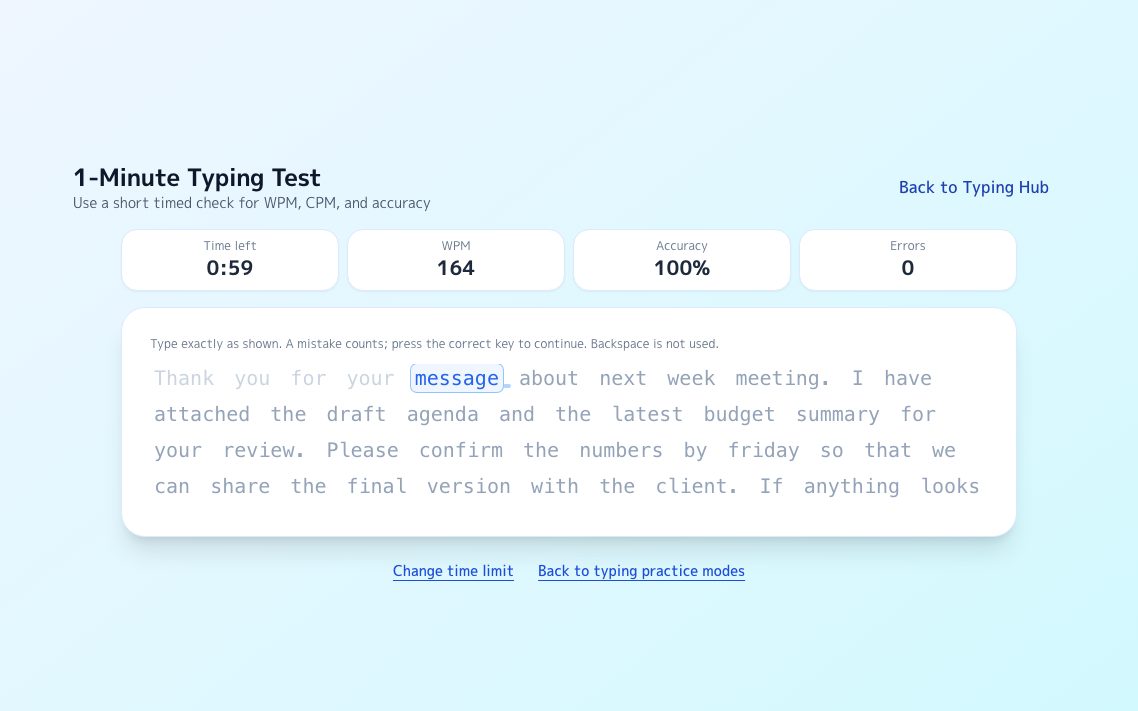
Continuous text scrolls as you type, reporting WPM and accuracy on the spot.
Try it →
Standard drillEnglish Typing Practice
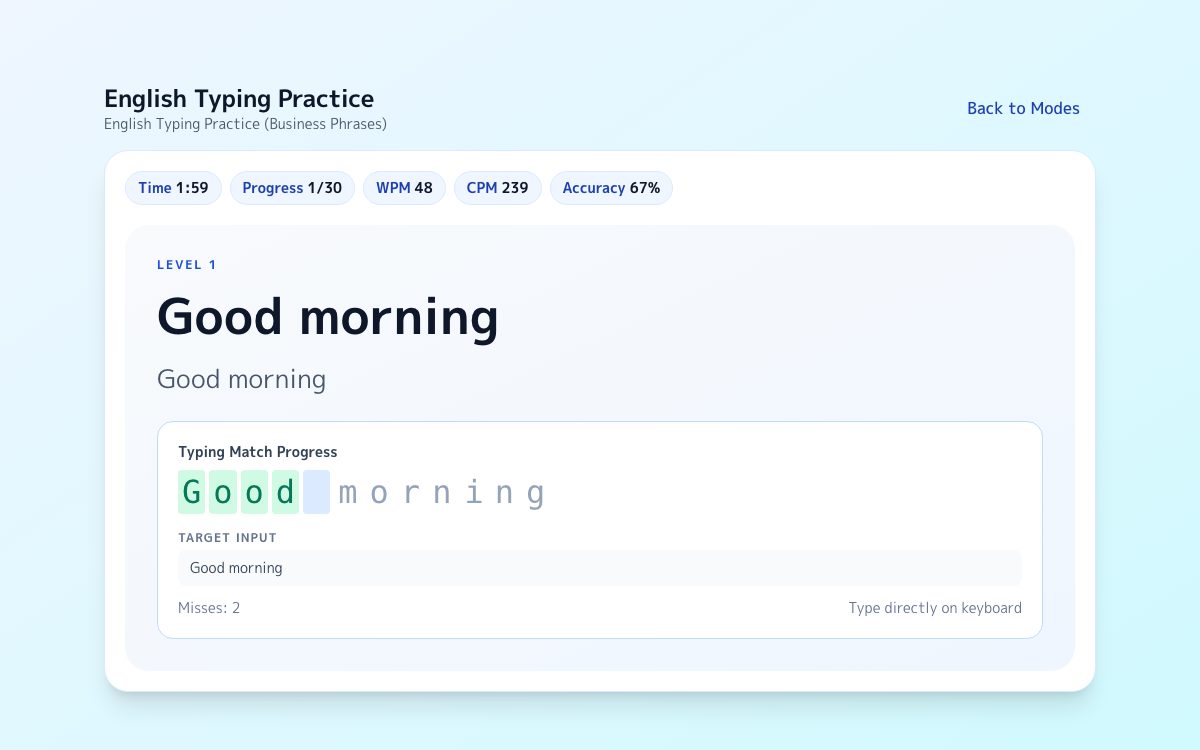
The default mode for building accuracy from short prompts to longer passages.
Try it →
Work checkBusiness Chat Practice
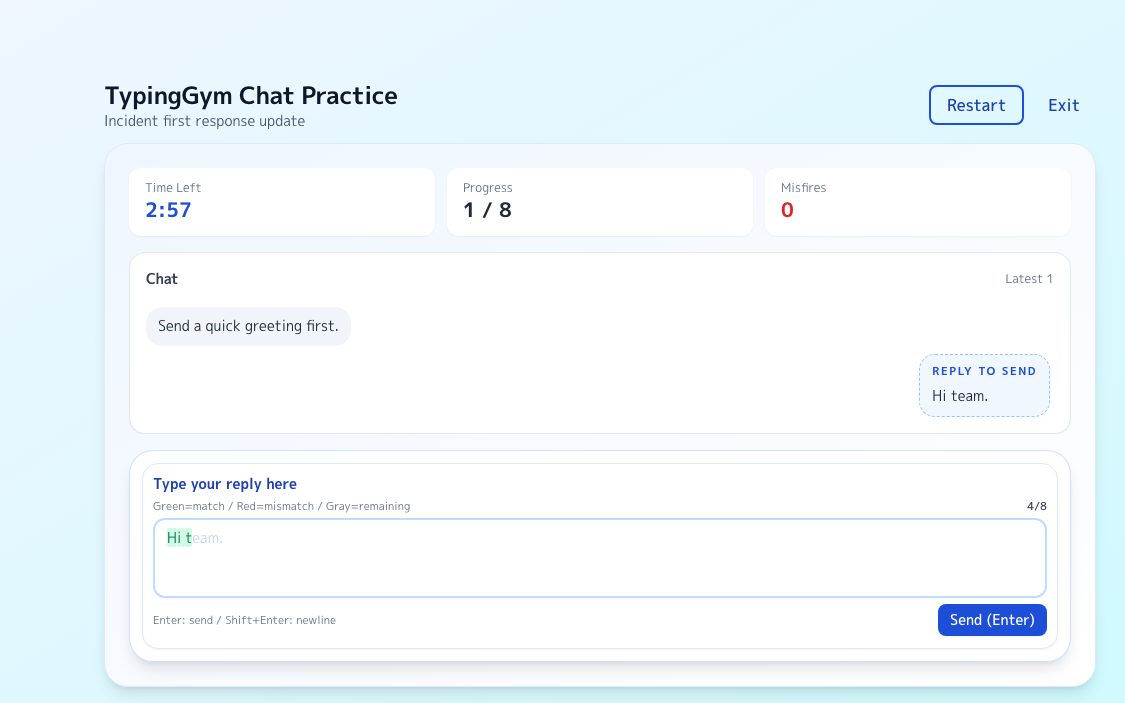
Validate repeatable accuracy on work-style messages with Enter and newline handling.
Try it →
FAQ
How fast should I type the alphabet?
Aim for under five seconds first (312 keystrokes per minute) — at that point you are no longer hunting for keys. Under four seconds is fast by office standards, under three is advanced, and around 2.5 seconds is competitive territory.
Is the text the same every run?
Yes. The A–Z Dash is always a to z in order, so nothing about the text changes between runs and the difference is entirely you.
Does capitalisation matter?
No, upper and lower case both count, so you never need Shift. Using it only adds keystrokes and slows you down.
What happens if I press a key before the gun?
That is a false start: the run ends immediately, nothing is recorded and nothing is sent to the ranking. Step up to the line again and you can retry as often as you like.
Do mistakes end the run?
No. Your runner stumbles until you hit the right letter, so a mistake costs roughly 0.2 to 0.4 seconds instead of the run.
Can I play on a phone?
You can, using the on-screen keyboard, but times on a physical keyboard are far quicker. If you are chasing a record, use a real keyboard.